

The Enduring Legacy of Macross: How a Groundbreaking Series Reshaped Anime Forever!

Written By: Ken Hulsey
In 1984, the animated television series Macross soared to new heights in popularity in Japan. Never before had an animated series captivated the Japanese public like Macross. While shows like Astro Boy, Kimba, Gigantor, Mazinger, and Gundam had amassed devoted young followings, Macross transcended age, class, and gender barriers in a way no anime had before it. Songs from the series, sung by voice actress Mari Iijima as the character Lynn Minmay, were climbing the charts one after another. In fact, Lynn Minmay had become as much of a pop culture phenomenon in Japan as Madonna was in America, despite being a fictional character.
Recognizing Macross' widespread popularity, directors Noboru Ishiguro and Shoji Kawamori began work on a big-screen adaptation of the series. A theatrical release would allow for higher production values, crisper animation, and a more mature storyline. The challenge would be condensing the TV series's numerous episodes and complex plot into a 114-minute film. But Ishiguro and Kawamori were up to the task, determined to preserve the elements that made Macross a hit - transforming mecha, unique spaceships, and a character-driven narrative.
When The Super Dimension Fortress Macross: Do You Remember Love? premiered in Japanese theaters on July 21, 1984, it became an instant box office sensation.
As was the case in the classic Macross television series, the plot would revolve around Hikaru Ichijyo (Arihiro Hase), a daredevil-turned-fighter pilot. Ichijyo finds himself entangled in a complicated love triangle, torn between his feelings for a young Chinese pop star named Lynn Minmay and a strong-willed military officer named Misa Hayase (Mika Doi).
As in the original show, Minmay's rising fame proves too much for the young pilot to handle. Through a series of dramatic events, Ichijyo ends up paired with the stern yet vulnerable Hayase.
In 2009, an alien battleship crash-lands on Earth and is rebuilt through a collaborative effort by the world's governments. Soon, a race of giant aliens arrives, searching for the ship. Before humanity can comprehend the situation, it finds itself caught in a three-way battle. It is then discovered that these giants, known as Zentradi and Meltlandi, are actually at war with each other. Unlike the television series, where the male Zentradi and female Meltlandi never interacted, the movie adaptation depicts the two genders engaged in an all-out war, with the human race becoming embroiled in the ultimate battle of the sexes.
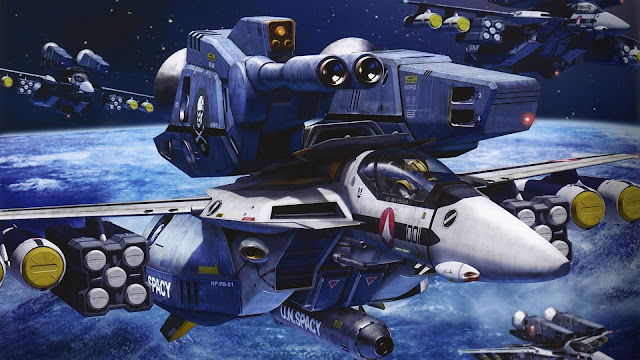
In an attempt to quickly escape the space fortress, the captain ordered a fold maneuver to instantly transport the ship and crew to another point in space, hoping to get them out of harm's way. Unfortunately, the maneuver was executed too close to a nearby island, which was transported along with the battleship. The island's inhabitants, including their homes and businesses, were quickly rescued and brought aboard the ship, where they worked to reconstruct Macross City and resume a normal existence.
The Zentradi soon tracked the vessel and launched an all-out effort to prevent the humans and their battle fortress from reaching Earth. During the conflict, both the Zentradi and Meltlandi became obsessed with human culture, which they referred to as "Protoculture" or a prototype culture. They were particularly fascinated by the music of pop sensation Lynn Minmay.
In the end, it was an ancient song sung by Minmay that led to peace between the three warring factions.

A year after the release of "The Super Dimension Fortress Macross: Do You Remember Love?" in Japanese theaters, the original Macross series would reach American audiences through the Robotech television series. This sparked growing interest in the theatrical Macross film on this side of the Pacific. In the late 1980s, Celebrity Home Entertainment (Just For Kids) released a heavily edited VHS version under the title "Clash of the Bionoids," aimed at young adults. This edited version removed most of the movie's violent battles and Lynn Minmay's shower scene, much to the disappointment of American Macross/Robotech fans.
As in the original show, Minmay's rising fame proves too much for the young pilot to handle. Through a series of dramatic events, Ichijyo ends up paired with the stern yet vulnerable Hayase.

In an attempt to quickly escape the space fortress, the captain ordered a fold maneuver to instantly transport the ship and crew to another point in space, hoping to get them out of harm's way. Unfortunately, the maneuver was executed too close to a nearby island, which was transported along with the battleship. The island's inhabitants, including their homes and businesses, were quickly rescued and brought aboard the ship, where they worked to reconstruct Macross City and resume a normal existence.
The Zentradi soon tracked the vessel and launched an all-out effort to prevent the humans and their battle fortress from reaching Earth. During the conflict, both the Zentradi and Meltlandi became obsessed with human culture, which they referred to as "Protoculture" or a prototype culture. They were particularly fascinated by the music of pop sensation Lynn Minmay.
In the end, it was an ancient song sung by Minmay that led to peace between the three warring factions.

A year after the release of "The Super Dimension Fortress Macross: Do You Remember Love?" in Japanese theaters, the original Macross series would reach American audiences through the Robotech television series. This sparked growing interest in the theatrical Macross film on this side of the Pacific. In the late 1980s, Celebrity Home Entertainment (Just For Kids) released a heavily edited VHS version under the title "Clash of the Bionoids," aimed at young adults. This edited version removed most of the movie's violent battles and Lynn Minmay's shower scene, much to the disappointment of American Macross/Robotech fans.
Unfortunately, a proper DVD release of the film has never materialized in the United States. This is due to an ongoing legal dispute between the production companies Big West, Tatsunoko Pro, and Harmony Gold (who produced the Robotech series). Many companies have expressed interest in releasing the film on DVD, but the complex legal situation has prevented a proper release so far. As a result, "The Super Dimension Fortress Macross: Do You Remember Love?" risks becoming a lost treasure in the annals of Japanese animation releases in the United States.

The 1984 anime film "The Super Dimension Fortress Macross: Do You Remember Love?" (also known as "Chôjikû yôsai Macross: Ai oboeteimasuka" or "Clash of the Bionoids") was directed by Noboru Ishiguro and Shôji Kawamori. The story was written by Shôji Kawamori, with the screenplay by Sukehiro Tomita. The talented voice cast included Mari Iijima as Lynn Minmay, Arihiro Hase as Hikaru Ichijyo, Mika Doi as Misa Hayase, and many others. This beloved anime film was released in Japan on July 21, 1984.
The legacy of Macross continues!

Continuing the Legacy: Macross Plus and the Original Macross
The Macross franchise, which began with the groundbreaking 1982 series "Super Dimension Fortress Macross," set a high standard for storytelling, character development, and innovative animation in the anime world. It masterfully blended science fiction with themes of love, war, and music, captivating audiences with its rich narrative and memorable characters.
Fast forward to 1994, when "Macross Plus" debuted as a four-episode OVA series. Directed by Shinichiro Watanabe, known for his later work on "Cowboy Bebop," and designed by Shoji Kawamori, one of the original creators of Macross, this new installment continued to build on the legacy of its predecessor. Set in the same universe, "Macross Plus" introduced a new generation of fans to the franchise while also appealing to long-time followers.
At its core, "Macross Plus" retained the hallmark themes of its forebear. The triumphant return of music as a central element reinforced the emotional depth of the story. With an emphasis on the relationship between humanity and technology, the series examined the implications of advanced artificial intelligence, best exemplified through the iconic character of Sharon Apple. The integration of cutting-edge Valkyrie designs and breathtaking animation signified a significant evolution in the franchise's visual storytelling, showcasing the advancement in anime technology since the original series.
The OVA's complex characters, particularly the rivalry between pilots Isamu Dyson and Guld Goa Bowman, echoed the interpersonal conflicts and romances that made the original Macross resonate with viewers. Their struggles not only reflect the timeless themes of rivalry and redemption but also connect them to the larger narrative of love and sacrifice that has become a staple of the franchise.
Ultimately, "Macross Plus" served not only as a tribute to the original series but as a milestone in the Macross saga, deepening its mythology. The reimagined story, along with the introduction of new elements, ensured that the franchise remained relevant and appealing to new audiences. The subsequent release of the movie edition brought even more depth to the narrative, solidifying its place in the annals of anime history.
In essence, "Macross Plus" not only honored the legacy of the original Macross but also expanded its universe, paving the way for future installments and capturing the hearts of both returning fans and newcomers alike. The series continues to exemplify how storytelling can evolve while retaining the core elements that made a franchise beloved in the first place.

As fans of the legendary Macross franchise celebrate its enduring legacy, Macross Frontier emerges as a significant chapter that honors its roots while advancing the narrative. Commemorating the 25th anniversary of the original Super Dimension Fortress Macross series, which aired from 1982 to 1983, Macross Frontier seamlessly weaves together elements from its predecessors, particularly the beloved Macross Plus.
Set in the year 2059, Macross Frontier is positioned intriguingly in the timeline—47 years after the original series and 13 years post-Macross 7. This latest installment introduces audiences to the 25th Colonial Fleet, aptly named the Macross Frontier, which navigates the depths near the galactic center. Embodying a harmonious blend of human and Zentradi influences, the fleet's design reflects the signature aesthetics of the franchise while pushing the creative boundaries of visual storytelling.
One of the standout features of Macross Frontier is the VF-25 Messiah, a state-of-the-art variable fighter that symbolizes humanity's ongoing evolution in the face of extraterrestrial threats. This evolution is reminiscent of the technological leaps seen in Macross Plus, where advanced mecha played a pivotal role in both combat and character development. The introduction of the Vajra, a new alien menace with formidable biomechanical capabilities, aligns with the franchise's longstanding tradition of intense battles between innovative technology and powerful adversaries.
However, what truly sets Macross Frontier apart is its commitment to the core theme of the Macross Universe: the fusion of music and warfare. Just as music was central to the narrative and character dynamics in Macross Plus, this series continues to explore how melody and harmony can resonate amid chaos and conflict. The power of song becomes a weapon against despair and destruction, reinforcing a message that transcends time and resonates with audiences across generations.
In addition to the animated series, Macross Frontier has inspired two manga adaptations, further expanding its reach and narrative depth. These adaptations, which began publication in 2008, indicate a thriving franchise that appeals to both longtime fans and newcomers eager to explore the intricacies of this universe.
Ultimately, Macross Frontier is a testament to the legacy of the original Macross and Macross Plus. It invites viewers to reflect on the themes of resilience, unity, and the transformative power of music, ensuring that the franchise remains as relevant today as it was a quarter-century ago. As we continue to explore the stars alongside these beloved characters, Macross Frontier stands as a proud contender in the illustrious saga of Macross, blending nostalgia with innovation in a celebration of the past and a hopeful gaze toward the future.

Robotech: Macross Repackaged for an American Audience
The creation of "Robotech" was initiated by Carl Macek, who was dissatisfied with the crude alterations made to "Gatchaman" in the adaptation known as "Battle of the Planets." His goal was to import an anime series that could be translated faithfully for the Western market. Unfortunately, the best series he could acquire, "Chôjikû yôsai Macross," consisted of only 36 episodes, which was too few for the standard 65-episode syndication package demanded by the North American TV market. To resolve this issue, Macek decided to acquire two other similarly themed series: "Chôjikû kidan Sazan Kurosu" and "Genesis Climber Mospeada." He then connected these series into a grand epic that followed generations of characters forced to fight three successive wars over an alien energy source known as Protoculture, which the enemy was desperate to capture.
The series concluded with an unresolved ending that was not continued until the release of "Robotech: The Shadow Chronicles" over 20 years later.
The First Robotech War (The Macross Saga) focuses on humanity's discovery of a crashed alien ship and the subsequent battle against a race of giant warriors called the Zentraedi, who have been sent to retrieve the ship for unknown reasons. During this chapter, Earth is nearly destroyed, the Zentraedi are defeated, and humans gain knowledge of the energy source known as Protoculture. Humanity also learns about the Robotech Masters, whose galactic empire the Zentraedi protected and patrolled.
The Second Robotech War (The Masters) centers on the arrival of the Robotech Masters in Earth's orbit, who seek what turns out to be the only means in the universe of producing Protoculture. Their attempts to retrieve this energy source, fueled by mistrust and arrogance, meet resistance from humans, sparking a war that leaves the Masters defeated and Earth inundated with spores from a plant called the Flower of Life—the source of Protoculture and a signal to the mysterious Invid, who scour the galaxy for its presence.
The Third Robotech War (The New Generation) begins with the arrival of the Invid on Earth, drawn by the Flower of Life, which results in their rapid conquest of the planet. References from the previous two chapters indicate that many heroes from the First Robotech War had left Earth to locate the Robotech Masters on a preemptive mission. This Robotech Expeditionary Force sends missions back from across the galaxy to attempt to liberate their homeworld. The storyline follows a group of freedom fighters as they strive for the final battle against the Invid.

Harmony Gold attempted to produce several sequels to the original series, most notably "Robotech II: The Sentinels," but only enough footage for a single feature was completed. The project fell through due to issues with toy licensing and changes in the Japanese yen-US dollar exchange rate, among other factors. The Sentinels saga continued to be documented in novelizations by Jack McKinney and comic book adaptations by the Waltrip brothers.
"Robotech: The Shadow Chronicles" was first announced at Anime Expo 2004 as the latest installment in the Robotech saga. Unlike previous attempts, this movie serves as a direct continuation of the last episode of the original series. The first teaser trailer debuted a year later at Anime Expo 2005 in celebration of the 20th anniversary of Robotech. The 88-minute movie premiered at various film festivals in 2006 and had a limited theatrical release in January 2007, though the DVD release was delayed until February 6, 2007.

From Anime to Arena: The Enduring Legacy of Mecha in Battletech and MechWarrior
The connections between the iconic franchises of "Battletech," "MechWarrior," and Japanese anime such as "Macross" and "Robotech" run deep, creating a rich tapestry of storytelling and mecha design that has captivated fans for decades. "Robotech," a pioneering series that blended different anime to create a cohesive narrative, showcased giant robots in emotionally charged battles that left a significant mark on Western pop culture. Similarly, "Macross" introduced the concept of transforming mecha and complex character dynamics, paving the way for future robot-centric narratives.
"Battletech," drawing inspiration from these series, incorporates many design elements and thematic storytelling of the mecha genre, melding them with its own distinct universe of warfare and political intrigue. The game allows players to engage in tactical battles with giant robots, a clear homage to the thrilling conflicts portrayed in "Robotech" and "Macross."
The role-playing game "MechWarrior" further expands on this legacy, allowing players to step into the shoes of pilots navigating personal and interstellar conflicts. By integrating characters, lore, and technologies reminiscent of Japanese anime, "MechWarrior" creates an immersive experience that resonates with fans familiar with the original source material.
As the "Battletech" universe grew, so too did its influence on video games, with titles based on "MechWarrior" bringing the franchise into the digital age. The strategic gameplay, combined with a narrative and aesthetic reminiscent of classic Japanese mecha anime, has helped sustain the legacy of these beloved series, ensuring that the spirit of "Robotech" and "Macross" continues to thrive in tabletop and video gaming.
In this way, "Battletech" and "MechWarrior" not only pay homage to their anime antecedents but also serve as a bridge, introducing new generations to the excitement and depth of the mecha genre.

RoboTech: Part 1 - The Macross Saga - Blu-ray + Digital


Comments
Post a Comment