Discover A Gothic Gem - Step Inside History: Unveiling the Marvels of Louisiana’s Old State Capitol | Ken Hulsey Photographer


A while back, I had the privilege of spending my lunch break at the historic Old State Capitol in downtown Baton Rouge. This gothic castle-style building once housed the legislators who deliberated on the affairs of the Pelican State, and it is now a first-rate museum dedicated to Louisiana's history.


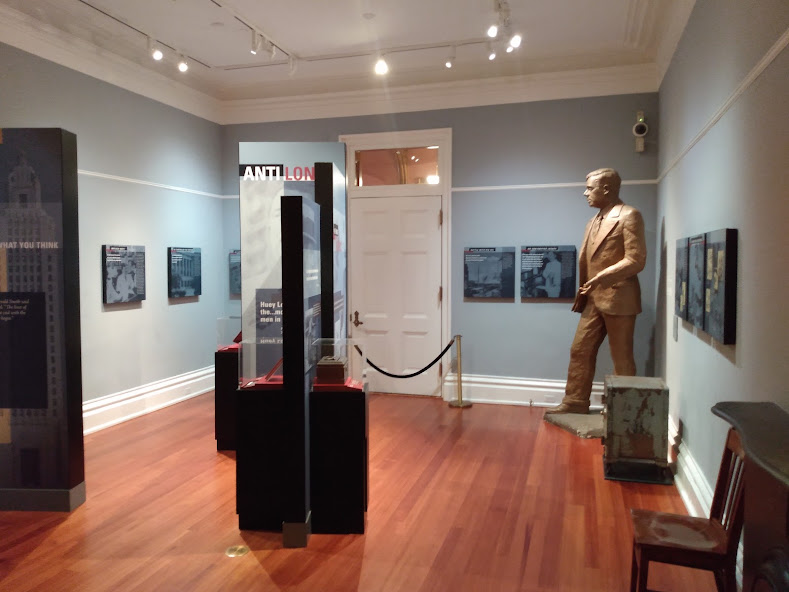
If you are impressed by the castle-like exterior, you will be amazed by what you find inside. The lower floor features exhibits that focus on the history of the Capitol building, the early days of Louisiana, and its most famous figure, the infamous Huey P. Long. A majestic circular staircase leads to the second floor, which includes an impressive ballroom, a spacious auditorium, and an elaborately decorated foyer with a stunning stained glass mosaic skylight overhead. 

It truly has to be seen to be believed!

- Story and Photos by Ken Hulsey

From The Old State Capitol Website:

Louisiana's Old State Capitol, a Gothic architectural treasure, stands high on a bluff overlooking the Mississippi River. The 165-year-old statehouse has withstood war, fire, scandal, bitter debate, abandonment and an occasional fistfight. Today, the building stands as a testament to bold, inspired leadership and active citizenship.

In 1990, the Louisiana Legislature placed the former statehouse under the jurisdiction of the secretary of state and appropriated funds for a major restoration project. The building re-opened as the Center for Political and Governmental History in 1994. Now referred to as the Museum of Political History, the Old State Capitol has received awards for its architecture, exhibits and preservation. 

The Old State Capitol has such an interesting history:

By the 1860s with a possible Civil War on the horizon, legislatures met in the House Chamber to discuss the state’s position on secession under Gov. Thomas Overton Moore. On January 26, 1861 the legislature voted to secede from the United State of America. The scene from inside the statehouse was described by the Weekly Gazette & Comet as “a shout as never before went up from the old Gothic Building.” Louisiana became The Sovereign and Independent Commonwealth of Louisiana for two months before joining the Confederate States of America. In 1862, the state government left the capitol and fled Baton Rouge in advance of Union troops. The capitol was moved to Opelousas and then to Shreveport. Union troops quickly took over the capitol building and used it as a command post, prison and garrison. Union troops occupying the building allowed a fire in the northwest turret to rage ultimately causing a catastrophic fire that gutted the building. The exterior walls were the only things that remained.

In 1866, with the Civil War now over, the state capitol was re-established in New Orleans and the building remained vacant.The state constitutional convention of 1879 stated that Baton Rouge was once again to become the seat of government in Louisiana. The legislature allocated $153,000 to repair the statehouse and appointed William A. Freret as architect. Freret’s vision of a fourth floor, cast iron spiral staircase, stained glass dome and exterior towers were approved and reconstruction of the building began. The newly reconstructed capitol building was complete in 1884. In the following years fiery debates and fist fights broke out throughout the building, namely over the first Louisiana Lottery. In 1906, a fire in the Senate chamber caused extensive damage to the east wall of the building and water damage throughout. The legislature provided funds for repairs. Part of those repairs included removing the iron turrets atop of the main towers.

Discover More 

Here are my photos:


Check Out:


Historic Neighborhoods of Baton Rouge (American Chronicles) Paperback – by Annabelle M. Armstrong


Baton Rouge is known for its rich history, food, politics, music and universities. Perhaps overlooked are the stories of how this large port city's close-knit neighborhoods have adapted to changes over the years. Annabelle Armstrong deftly navigates the evolution of these historic communities, showcasing southern charm and romanticism through firsthand accounts of people who call these places home. Journey back to the beginnings of Hundred Oaks, Capital Heights, University Acres, Wimbledon, Tara, Inniswold, Glenwood, Walnut Hills, Stratford, Steele Place, Broussard, Southdowns and many more popular places to settle down.

Comments

Popular posts from this blog

Unmasking Heroes: The Untold Stories Behind the Birth of Comic Book Legends

Written By: Terri Pressley  Where does a documentary about superheroes and comics begin? With Superman himself, of course! Superman, created in 1938 by Jerry Siegel and Joel Shuster, both 18 years old, combined parts of Hercules, a scientific Moses, and Jerry Siegel's confidence issues. He always had crushes on girls that didn't seem to know that he was alive, so he created a character that everyone would look up to, one that women would want and men would want to be.

Unleash Your Inner Explorer: May Magic Awaits in Santa Fe!

Discovering Santa Fe: May Events for Young Tourists Santa Fe , a gem of the Southwest, is a vibrant city known for its rich cultural heritage, stunning landscapes, and a host of exciting events. As summer approaches, young tourists flock to this artistic haven to experience everything from literature to local cuisine. If you're planning a visit in May, brace yourself for a whirlwind of activities perfect for making unforgettable memories.

You Have More Power Than You Think: How to Activate God’s Power in Your Life

The Wordless Book: Black - Stands For Sin In Our Lives, Red - Stands For The Blood Jesus Shed On The Cross, White - Represents Salvation Through Jesus, Gold - Represents The Kingdom Of Heaven. What if the power you’ve been searching for is already within you, but you haven't activated it yet? In this message, we kick off the series Power, Passion, and People with a foundational truth: God has already placed His power within every believer through the Holy Spirit. The challenge is not in receiving power; it’s in learning how to walk in it.

Chasing Shadows of the Past: A Railroad Adventure with Kansas City Southern's Vintage F-Series Locomotives

Photos and Story by Ken Hulsey In April 2022, I received a tip from a fellow railfan on Facebook that the Kansas City Southern Executive Train would be in Baton Rouge . To my excitement, I spotted a set of vintage FP9/F9B diesel locomotives resting on a bridge over the 110 freeway while driving toward downtown. My enthusiasm for the F-series locomotives compelled me to navigate some of Louisiana's poorly designed streets (and that’s saying something) to get close to the railyard. I made my way through what felt like a jungle that belonged somewhere in Borneo, only to climb a steep hill to reach the railyard.

Bedrock City Still Lives! - Travel To The Home of The Flintstones - Valle Arizona

Story By Ken Hulsey Photos From The Raptor Ranch Website : This morning, while browsing the internet, I came across an excellent article in Route Magazine (The Official Route 66 Magazine) about the history of Bedrock City in Arizona . Built in 1971 by Woody and Francis Speckels, the park was originally an amusement park inspired by the famous Hanna-Barbera cartoon, The Flintstones. Over the decades, Bedrock City became a popular stop for families traveling between the town of Williams and the South Rim of the Grand Canyon .

The Timeless Appeal of The Pretenders' "Learning to Crawl"

For classic rock enthusiasts, the Pretenders hold a special place in the pantheon of iconic bands that shaped the soundscape of the late '70s and early '80s. Formed in March 1978, the band made an indelible mark through a blend of punk energy, rock sensibility, and poignant songwriting, primarily driven by the incomparable Chrissie Hynde. One of their standout works, "Learning to Crawl," remains a treasured album that resonates deeply with fans even decades later.

Exploring Shreveport: A Photojournalist's Journey Through History and Abandonment

 Story & Photos By Ken Hulsey I have to admit that Shreveport is probably my favorite city in Louisiana . The city features stunning visual contrasts, and as a photojournalist, walking around provides countless opportunities to capture thought-provoking images. I spent some time in downtown Shreveport this week and took a lot of great pictures. The area is rich with things to see, including many abandoned buildings, which can be found in every city and town in the state, as well as preserved historical landmarks and modern art and architecture.

Unleashing Faith: How to Conquer Life's Impossible Odds with God's Strength

  Facing Impossible Odds: Trusting in God's Strength Have you ever found yourself in a situation that felt overwhelming, where the challenges seemed insurmountable? It's one of those moments when you're backed against the wall, wondering if there's a way out at all. Yet, for those who believe, even the most daunting circumstances are not too big for God to handle. In fact, it's often in these moments of difficulty that we learn to rely not on our own strength but on His divine power.

Unlocking Divine Strength: How to Tap into the Power Within You!

Life can sometimes feel overwhelmingly challenging, as if every obstacle is stacked high against you. In moments like these, it’s essential to remember that no challenge is too great for God to overcome. He knows you intimately, even better than you know yourself . Have you tapped into the immense power of God in your life? Do you even realize that you hold this divine power within you?

Just a Thought: Designed by God | Pastor Steve Smothermon

Designed by God Psalm 139 is a profound reminder of God's intimate knowledge and omnipresence in our lives. The psalm opens with a declaration of God's deep knowledge of the individual: "O Lord, you have searched me and known me." This knowledge is not just superficial awareness, but a profound, penetrating understanding of all our ways. The psalmist acknowledges that before a word is on our tongues, God knows it completely. This reveals a God who is not distant or disinterested but is deeply engaged with the intricacies of our lives, understanding our thoughts and actions better than we understand them ourselves.